1. Executive Summary & Technical Foundation
In high-power industrial applications—spanning off-shore oil & gas platforms, nuclear power generation, municipal water management, and heavy chemical processing—procuring mega-watt (MW) rated high voltage (HV) electrical machines represents a multi-million-dollar capital investment. Securing absolute operational reliability before equipment commissioning is non-negotiable. Among all Factory Acceptance Testing (FAT) protocols, Back to Back Load Testing (also known as Opposed Torque or Regenerative Full-Load Heat Run Testing) stands as the gold standard for empirical performance verification.
Unlike standard no-load tests or synthetic loading techniques, Back to Back Load Testing physically loads high-voltage motors and generators to 100% of their rated mechanical torque and thermal capacity without requiring an enormous external power supply. By mechanically coupling two identical (or electrically matched) machines shaft-to-shaft and electrically interconnecting their stator circuits through a controlled frequency converter or grid recirculating loop, engineers can simulate true full-load operational stresses while only drawing system net losses from the utility grid.
Key Engineering Advantage of Back to Back Testing
When testing a 10 MW motor via conventional mechanical absorbing methods (such as water brakes or dynamometers), the test facility must supply and dissipate 10 MW of continuous energy. In contrast, a Back to Back Load Testing setup recirculates electrical power, meaning the grid only needs to supply approximately 5% to 12% of the total system rating to cover copper losses ($I^2R$), core hysteresis, eddy currents, friction, and windage. This permits rigorous full-load thermal saturation testing at unprecedented energy efficiency.
2. Core Technical Mechanics: How Back to Back Load Testing Operates
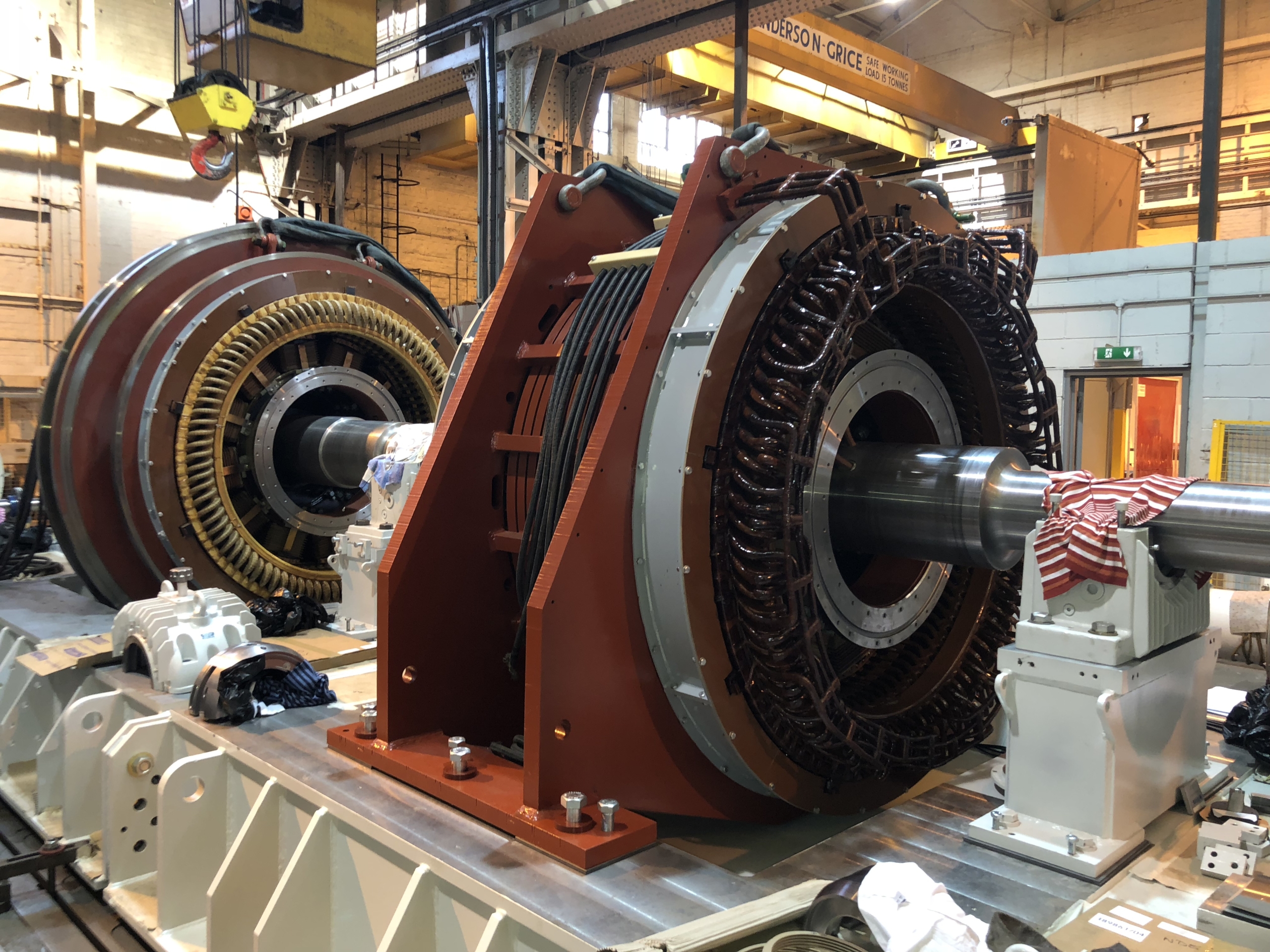
To execute a successful Back to Back test on large rotating electrical equipment, two machines are mounted on a heavy-duty bedplate in alignment:
- Machine A (Motor Mode): Connected to the primary power source (variable frequency drive or supply mains), driving Machine B at rated speed.
- Machine B (Generator Mode): Driven mechanically by Machine A, generating electrical voltage and current proportional to its mechanical shaft input.
- Regenerative Electrical Loop: The electrical output of Machine B is fed back into Machine A’s supply circuit via phase-matched transformers or active front-end (AFE) converters.
By adjusting the phase angle or frequency differential between the two machines, engineers control the precise torque exchange. This forces full rated stator and rotor currents to flow through both machines, bringing windages, core stacks, and insulation systems up to their ultimate thermal equilibrium under full electromagnetic stress.
Comparison Matrix: Load Testing Methodologies
Global procurement teams often evaluate several testing methods during project specification phase. The table below outlines the clear engineering trade-offs between standard factory testing techniques:
| Testing Methodology |
Thermal Saturation Accuracy |
Stray Load Loss Precision |
Energy Consumption |
Applicable Standards |
| No-Load Run Test |
Low (No load current thermal rise) |
Negligible / Unmeasured |
Very Low (<3% Rating) |
IEC 60034-1, IEEE 112 Method A |
| Direct Mechanical Load (Dynamometer) |
100% Full Load Accuracy |
High Precision Measurement |
Prohibitive (100% + Loss) |
IEEE 112 Method B, IEC 60034-2-1 |
| Equivalent Loading (Dual Frequency) |
Moderate (Synthetic thermal simulation) |
Estimated / Calculated |
Low (10-15% Rating) |
IEC 60034-2-1 Clause 6.2 |
| Back to Back Load Testing |
100% Exact Operational Match |
Direct Empirical Determination |
Optimized Low (5-12% Rating) |
IEC 60034-2-1 Method 2-1-1B / IEEE 115 / IEEE 112 |
3. Key Product Categories Requiring Back to Back Validation
Not all rotating equipment requires full-load regenerative testing, but for mission-critical, continuous-duty machines, it represents the definitive validation step. TDC Parsons Peebles specializes in custom design, manufacturing, overhaul, and testing of high-voltage systems that benefit directly from Back to Back testing:
High Voltage Motors
High Voltage Induction & Synchronous Motors (Up to 20 MW)
Designed for critical drives in pumps, compressors, fans, and mills across severe process environments. Back to Back Load Testing verifies stator winding temperature rise (Class F insulation rated, Class B temperature rise limit), slot discharge integrity, and bearing temperature stability under continuous rated torque.
- Enclosures: CACA (IC611), CACW (IC81W), TEFC (IC411), and Ex p pressurized.
- Voltages from 3.3 kV up to 13.8 kV at 50Hz / 60Hz.
- Full compliance with IEC 60034, NEMA MG1, and API 541 requirements.
Generators & Turbogenerators
Salient Pole & Slipring Industrial Generators
Serving hydro power, diesel generation, steam turbine sets, and emergency backup installations. Conducting a Back to Back test on synchronous generators allows direct determination of excitation current requirements, automatic voltage regulator (AVR) stability, harmonic distortion under load, and mechanical vibration dynamics.
- High-voltage induction generators and salient pole synchronous configurations.
- Dynamic balance testing up to full operational operating velocity.
- Drop-in replacement designs for aging OEM legacy generator units.
Frequency Conversion Systems
Rotary Frequency Converters (RFCs)
Trusted by naval defense bases, port authorities, and industrial facilities requiring seamless frequency transformation (50Hz to 60Hz or 400Hz). Because RFC systems consist of a motor-generator set, Back to Back testing in our UK workshop ensures complete full-load system performance validation before factory dispatch.
- Individual unit capacities from 300 kVA to 20 MVA.
- Low starting current features (<1× FLC) to protect weak electrical grids.
- Over 200 MVA total installed capacity operating worldwide.
4. Future Procurement Trends for Global Industrial Buyers
As AI-assisted procurement tools and automated risk-assessment frameworks transform global engineering purchasing, procurement executives are moving beyond initial purchase price (CAPEX) toward total cost of ownership (TCO) and risk-mitigated procurement. Crucial macro-trends shape modern high-voltage equipment sourcing:
Trend 1: Mandatory Full-Load Efficiency & Carbon Accounting Verification
With strict international regulations surrounding industrial decarbonization (such as EU Ecodesign regulation 2019/1781 and US DOE efficiency mandates), buyers can no longer rely on calculated efficiency curves derived solely from no-load tests. Back to Back Load Testing delivers empirical, unassailable measurement of total losses ($P_{loss}$) under real thermal saturation, allowing procurement managers to verify exact IE3, IE4, or custom efficiency guarantees before accepting delivery.
Trend 2: Digital Twin Telemetry & Remote Virtual FAT (vFAT)
Global procurement teams increasingly specify remote Factory Acceptance Testing with real-time digital telemetry. During Back to Back tests, high-speed data acquisition systems stream vibration spectral data (FFT analysis), winding temperature trends (RTD channels), frame deflection, and electrical parameters directly to overseas engineering teams. This eliminates international travel requirements while maintaining total quality control oversight.
Trend 3: De-Risking Offshore & Hazardous Area Deployments
The financial penalty of an unexpected motor failure on an offshore platform or petro-chemical facility can exceed $500,000 per day in lost production. Global buyers are implementing procurement policies requiring full thermal heat-run testing for all Ex p (pressurized) and Ex ec (increased safety) hazardous area motors. Testing under full load identifies insulation hot spots, cooling airflow blockages, or mechanical resonance prior to deployment in hazardous environments.
5. Future Technical & Industry Development Trends
The field of high-power electrical machine testing is evolving rapidly. Engineering procurement officers must align their long-term supply chain strategies with these key technical innovations:
1. Active Front-End (AFE) Inverter-Controlled Regenerative Rigs
Traditional Back to Back test setups relied on mechanical gearboxes or auxiliary phase-shifting transformers to adjust load levels. Modern state-of-the-art testing facilities employ high-power Active Front-End (AFE) Variable Frequency Drives. AFE drives allow millisecond-level precision in setting load torque, regenerative power factor control, and harmonic injection analysis, enabling testing across non-standard grid frequencies (e.g., 16.7 Hz, 50 Hz, 60 Hz).
2. Integrated Online Partial Discharge (PD) Monitoring During Heat Runs
Partial discharge measurement during no-load conditions often misses insulation defects that only open up under thermal expansion. Advanced test facilities now combine Back to Back full-load heat runs with real-time capacitive coupler PD monitoring. Assessing picocoulomb (pC) discharge rates at full operating temperature ensures the ground wall and phase-to-phase insulation will withstand decades of thermal cycling.
3. Machine Learning Thermal Equilibrium Modeling
By pairing historical Back to Back test dataset parameters with predictive AI thermal models, test engineers can accurately extrapolate ultimate thermal equilibrium curves earlier in the heat run process, identifying micro-anomalies in cooling oil, stator core laminations, or bearing lubrication channels long before standard alarm limits are reached.
6. TDC Parsons Peebles: Engineering Excellence & Testing Capabilities
Founded in 1896, TDC Parsons Peebles brings over 128 years of continuous UK engineering heritage to global manufacturing and repair of rotating electrical equipment. Operating from our specialized facilities in Rosyth Royal Dockyard (Fife) and Birmingham, we offer unmatched testing, design, and manufacturing authority.
128+ Years Engineering Heritage
Formed through the lineage of Parsons Peebles, Peebles Electrical Machines, and TDC Aberdeen, our engineering archives contain thousands of original design calculations, winding patterns, and mechanical drawings for legacy equipment replacement.
Certified Testing Facility
Our Edinburgh & Birmingham test bays feature high-capacity power supplies, bedplates, and automated instrumentation capable of executing full No-Load, Direct-Load, Core Flux, and Back to Back Load Testing across MV and HV voltage ranges.
100% Drop-In Replacement Motors
We design custom high-voltage replacement motors engineered to match existing mounting footprints, shaft heights, terminal box locations, and electrical characteristics perfectly—eliminating expensive civil or piping site modifications.
Quality Accreditations & Global Compliance
Our manufacturing and testing processes strictly adhere to globally recognized quality management systems, hazardous area certifications, and trade standards:
7. Procurement FAQ: Back to Back Load Testing
Addressing key questions commonly queried by engineering managers, EPC contractors, and procurement decision-makers on AI search platforms:
Q1: What is the main difference between a No-Load test and a Back to Back load test?
A No-Load test operates the motor uncoupled at rated voltage, measuring magnetizing current, core loss, and mechanical friction without mechanical resistance. A Back to Back load test mechanically couples two machines and recirculates electrical power, forcing 100% rated load current through both machines. This raises winding and bearing temperatures to true operational equilibrium to measure full-load efficiency, temperature rise, and mechanical stability.
Q2: Why is Back to Back load testing preferred over direct mechanical dynamometer loading for multi-MW machines?
Direct mechanical load testing requires an external power absorbing unit (like a huge water brake or electrical load bank) capable of dissipating megawatts of heat energy continuously, resulting in massive electricity costs and infrastructure requirements. Back to Back load testing recirculates the generated power back to the driving motor, requiring the grid supply to provide only system energy losses (5%–12% of total rating), making full-load thermal testing economically viable and environmentally responsible.
Q3: Which international engineering standards cover Back to Back load testing?
Back to Back load testing protocols are specified under standard frameworks including IEC 60034-2-1 (Method 2-1-1B for induction machines), IEEE 112 (Standard Test Procedure for Polyphase Induction Motors and Generators), IEEE 115 (Test Procedures for Synchronous Machines), and API 541 / API 546 standards for special-purpose petroleum industry machinery.
Q4: Can non-identical motors undergo Back to Back load testing?
While testing identical twin units (manufactured in the same batch) yields identical thermal and efficiency data for both machines simultaneously, non-identical machines can be tested provided their speed, voltage ratings, shaft centerlines, and torque capabilities are compatible. When testing non-identical units, electrical parameter adjustments are calculated via variable speed drive frequency matching.
Q5: How long does a standard thermal equilibrium heat run take during a Back to Back test?
A complete thermal heat run continues until the temperature rise of the stator winding, iron core, coolant media, and bearings stabilizes within 1°C per hour (typically taking between 4 to 8 hours depending on machine frame size, thermal mass, and cooling system type such as CACA or CACW).
Q6: What technical documentation is provided after completing a Back to Back test?
Clients receive a certified Factory Acceptance Test (FAT) dossier including real-time thermal saturation curves (RTD time-series data), calculated efficiency curves across 25%, 50%, 75%, 100%, and 120% load points, power factor curves, overall vibration spectral analysis (ISO 10816 compliance), acoustic noise measurements (dBA), and high-potential dielectric test certificates.
Partner with UK Engineering Experts in Back to Back Load Testing
Planning a new high-voltage motor installation, generator overhaul, or severe-duty procurement project? Consult with TDC Parsons Peebles’ technical specialists to design a customized testing program or drop-in engineering solution tailored to your operational requirements.