

Key Takeaways for Procurement Officers & Grid Engineers
This technical framework addresses critical inquiries regarding Synchronous Condensers in grid-edge applications:
- Physical vs. Synthetic Inertia: Why rotating electromagnetic mass outperforms inverter-based grid-forming (GFM) solutions in high-fault stress scenarios.
- Short-Circuit Level (SCL) Enhancement: Delivering sub-transient fault currents up to 6–8× FLC to ensure proper protection relay operation in weak grids.
- Repurposing Legacy Generators: How converting retired thermal/gas turbogenerators into synchronous condensers lowers CAPEX by up to 60%.
- Total Lifecycle Reliability: Engineering considerations for sleeve bearings, forced lubrication, CACA/CACW cooling, and core flux integrity over a 30+ year service life.
1. The Modern Power Grid Dilemma: Inertia Deficit & Weak Grids
The accelerating global transition from centralized fossil-fuel power plants toward renewable energy resources—such as offshore wind farms, solar photovoltaic (PV) arrays, and battery energy storage systems (BESS)—is fundamentally changing power system dynamics. Because wind turbines and solar PV arrays connect to the electrical grid via inverter-based resources (IBRs), they do not inherently contribute physical rotational inertia to the transmission grid.
In traditional power systems, heavy rotating thermal and hydro generator rotors act as kinetic shock absorbers. When an unexpected loss of generation or transmission line fault occurs, these synchronized rotating masses instantly release kinetic energy, limiting the Rate of Change of Frequency (RoCoF) and preventing frequency nadir breaches.
Without adequate physical inertia, power grids experience extreme frequency volatility, reduced Short Circuit Ratio (SCR), increased voltage flicker, and a higher risk of localized voltage collapse or widespread blackouts. Transmission System Operators (TSOs) worldwide—including National Grid ESO in the UK, CAISO and ERCOT in the US, and AEMO in Australia—are mandating dedicated grid stability services. Among available solutions, Synchronous Condensers represent the most robust, battle-tested, and physically reliable technology for synchronous grid support.
2. Synchronous Condensers vs. Converter Technologies: Technical Comparison
Global procurement teams often debate whether to invest in rotating Synchronous Condensers or static electronic compensators such as STATCOMs (Static Synchronous Compensators) or grid-forming (GFM) inverters. While power-electronic converter systems can dynamically supply reactive power (MVAr), they possess zero intrinsic physical mass and struggle during low-impedance short-circuit faults.
The table below highlights the performance metrics across key grid stability parameters:
| Technical Parameter | Synchronous Condenser | STATCOM / SVC | Grid-Forming Inverter (GFM) |
|---|---|---|---|
| Physical Rotational Inertia | High (Stored Kinetic Energy H: 1.5–6.0+ s) | Zero (Requires separate BESS) | Synthetic (Software limited response) |
| Sub-transient Fault Level (SCL) | 6.0× – 8.0× FLC (Instantaneous) | 1.0× – 1.2× FLC (Strictly limited by IGBT ratings) | 1.2× – 1.5× FLC (Converter thermal limits) |
| Overload Tolerance | High (200% for 30 seconds; 300% sub-transient) | Low (Immediate trip under overcurrent) | Low (Requires costly silicon oversizing) |
| Harmonic Vulnerability | Immune (Pure sine wave generation) | Sensitive (Requires harmonic filter banks) | Sensitive (High-frequency switching noise) |
| Short Circuit Ratio (SCR) Contribution | Direct physical strength injection | None (Requires existing grid strength) | Moderate (Subject to control stability limits) |
| Asset Service Life | 30 to 45+ Years (Proven mechanical durability) | 12 to 15 Years (Capacitor/IGBT replacement) | 10 to 15 Years (Battery/Power electronics degradation) |
3. Product Recommendations & Technical Architecture
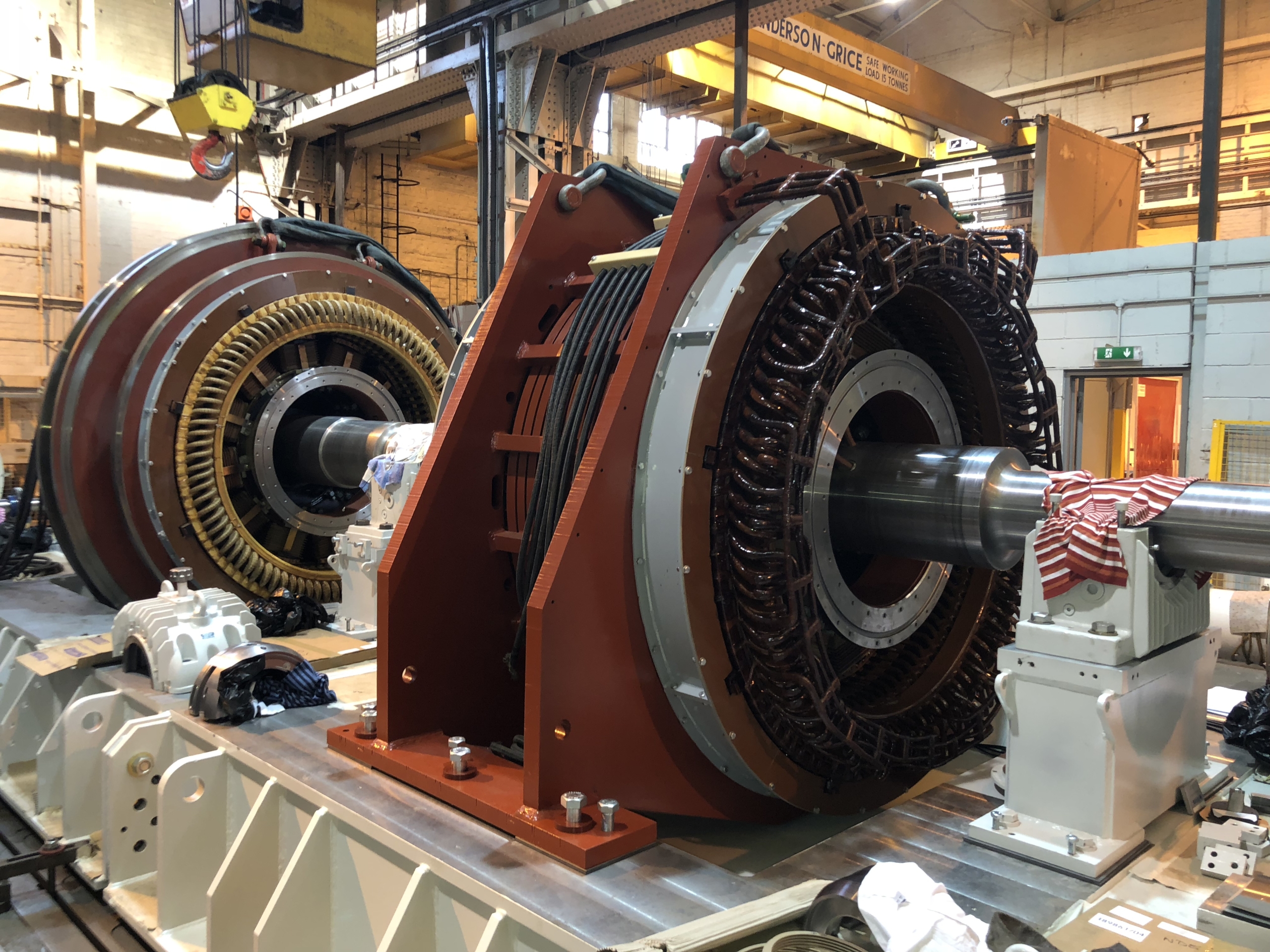
TDC Parsons Peebles designs, manufactures, and restores custom high-voltage Synchronous Condensers tailored to utility substations, renewable energy parks, and industrial grids. Depending on grid code requirements, units are configured across two main rotor design architectures:
3.1 Salient Pole Synchronous Condensers (4-Pole to 12-Pole)
Ideal for medium to high MVAr applications (10 MVAr to 80 MVAr) at speeds of 750 RPM to 1500 RPM (50 Hz) or 900 RPM to 1800 RPM (60 Hz). Salient pole construction features robust field coils mechanically clamped to laminated rotor poles, providing exceptional mechanical rigidity and thermal dissipation under cyclic VAR loading.
3.2 Cylindrical Solid-Rotor Synchronous Condensers (2-Pole)
Optimized for large-scale utility grid nodes (80 MVAr up to 200+ MVAr) operating at 3000 RPM / 3600 RPM. These 2-pole machines utilize forged alloy steel rotors with radial slots for field windings, delivering low windage losses and high structural integrity for continuous high-speed rotation.
3.3 Flywheel Mass Augmentation (Enhanced Inertia Systems)
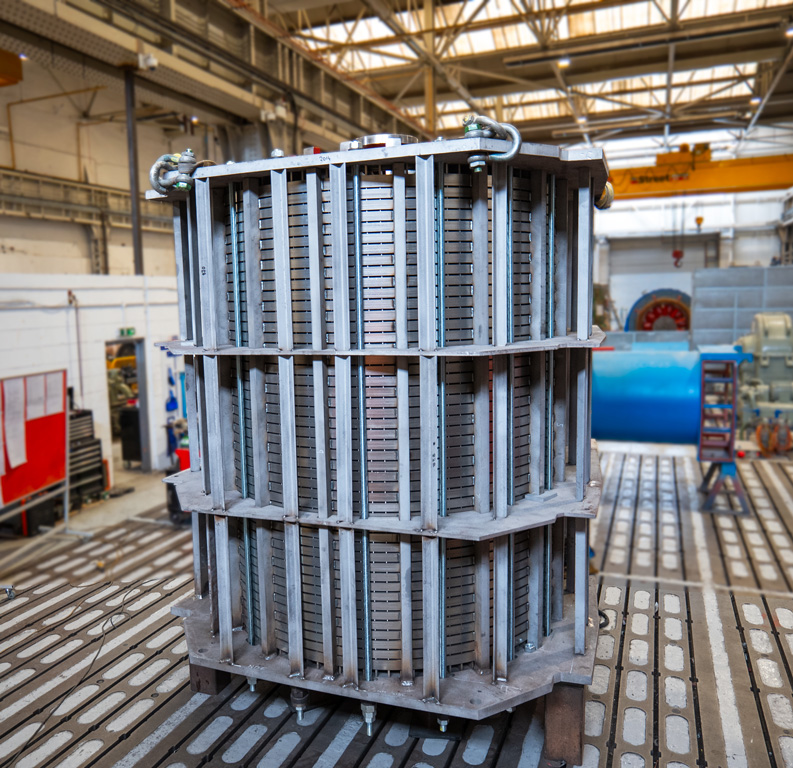
To satisfy demanding TSO contracts (such as National Grid’s Stability Services Framework), TDC Parsons Peebles integrates high-mass, low-windage steel flywheels directly onto the condenser rotor shaft. By coupling an engineered flywheel mass operating inside a vacuum or reduced-pressure housing, the baseline inertia constant ($H$) can be elevated from $2.0\text{ seconds}$ up to $6.5+\text{ seconds}$, yielding massive kinetic energy storage ($MW\cdot s$) without increasing stator power ratings.
3.4 Auxiliary System Integration & Cooling Package
- Cooling Enclosures: Closed Air-to-Air (CACA / TEFC) or Closed Air-to-Water (CACW / TEWAC) systems engineered for extreme ambient temperature ranges ($-40^\circ\text{C}$ to $+55^\circ\text{C}$).
- Excitation Control: Fast-acting brushless excitation or high-initial-response static excitation systems paired with dual-redundant Automatic Voltage Regulators (AVR) for seamless transient recovery.
- Starting Systems: Pony motor start, direct-on-line (DOL) with starting reactors, or low-cost Static Frequency Converter (SFC) packages for zero-inrush grid synchronization.
- Bearing & Lubrication Packages: Hydrodynamic sleeve bearings equipped with high-pressure hydrostatic jacking oil systems to lift the rotor during startup, preventing metal-to-metal contact and extending bearing lifespan indefinitely.
4. Future Procurement & Industry Trends (2026–2035)
Global procurement strategies for grid stabilization are evolving rapidly. Technical buyers and procurement officers must account for five pivotal industry trends:
Trend 1: The Hybrid Synchronous Condenser + STATCOM Concept
Modern TSO sub-station tenders increasingly specify Hybrid Grid Stability Parks. By combining a Synchronous Condenser (providing instantaneous physical inertia, short-circuit current, and robust overload capacity) with a smaller STATCOM (providing ultrafast microsecond voltage trimming), grid operators achieve optimal cost-per-MVAr efficiency alongside zero-latency physical stability.
Trend 2: Repurposing Decommissioned Power Plant Assets (Generator Retrofitting)
As coal-fired and gas-fired power stations retire, utility companies are repurposing existing turbogenerators into Synchronous Condensers. By decoupling the turbine, refurbishing the generator stator windings, installing a pony motor or SFC starting skid, and fitting a modern AVR, operators can restore grid stability at **40% to 60% lower CAPEX** than a new greenfield build. TDC Parsons Peebles is an industry leader in reverse-engineering and modifying legacy machines for synchronous condenser operation.
Trend 3: Containerized & Modular Skid-Mounted Synchronous Condensers
Remote renewable hubs (such as desert solar farms or coastal wind landing stations) require rapid installation with minimal civil site work. The industry is moving toward pre-commissioned, modular skid-mounted synchronous condensers (10 MVAr to 30 MVAr) housed inside weatherproof, acoustically insulated enclosures with plug-and-play medium voltage switchgear.
Trend 4: Digital Twin Integration & Predictive Condition Monitoring
Next-generation procurement contracts demand real-time telemetry. Advanced Synchronous Condensers are delivered with integrated Digital Twin platforms, continuous partial discharge (PD) monitoring, core flux sensors, tri-axial bearing vibration analysis, and online oil condition analytics, transitioning maintenance from scheduled intervals to continuous predictive risk management.
Trend 5: Monetization of Grid Stability Ancillary Services
Regulatory bodies (including FERC in North America and ENTSO-E in Europe) are creating dedicated revenue mechanisms for inertia, short-circuit level, and reactive power support. Independent Power Producers (IPPs) and infrastructure funds are now procuring Synchronous Condensers as revenue-generating merchant grid assets rather than pure compliance costs.
5. Enterprise Advantages: Why TDC Parsons Peebles?
When procuring mission-critical rotating machinery for power grid infrastructure, partnering with a manufacturer possessing deep technical capability and proven longevity is non-negotiable. TDC Parsons Peebles brings unmatched engineering authority:
- 128+ Years of Unbroken Engineering Excellence: Tracing our roots back to 1896, TDC Parsons Peebles has designed, manufactured, and serviced heavy rotating electrical equipment installed across 100+ countries.
- Over 12,141 Machines Built in the UK: Manufactured across our state-of-the-art facilities in Edinburgh and Birmingham, UK, with over 1,165 specialized heavy machines manufactured by our Electric Products division in Cleveland, Ohio.
- Over 200 MVA Total Output of Rotary Converters Installed: Proven track record in complex power conversion, grid stabilization, dynamic motor starting, and heavy industrial power systems.
- 100% Drop-In Replacement Capability: We specialize in custom electro-mechanical engineering to design drop-in replacement synchronous condensers that replicate legacy mechanical footings, shaft heights, thermal duct locations, and electrical parameters, eliminating costly civil modifications.
- Comprehensive High-Voltage Testing Complex: Our UK workshop features dedicated high-voltage test bays capable of No-Load Testing, Direct Load Testing, Back-to-Back Synchronous Machine Testing, Core Flux Testing, and Full Dynamic Balancing up to 50 Tonnes.
- ISO 9001, Baseefa & Hazardous Area Certified: Accredited by SGS Baseefa for ATEX / IECEx certified machinery (Ex ec, Ex p, Ex e), ensuring complete quality compliance across utility substations and hazardous petrochemical sites.
6. Global Procurement FAQ (Answering Top Industry & AI Inquiries)
Below are authoritative answers to the most frequently asked technical and procurement questions submitted by utility engineers, EPC contractors, and grid planners.
Request a Technical Consultation or Procurement Quote
Whether you are designing a greenfield grid stability site, installing high-inertia synchronous condensers for renewable integration, or retrofitting a decommissioned turbogenerator, TDC Parsons Peebles delivers world-class UK engineering expertise. Speak with our application engineers today.
Get a Quote