1. Technical Fundamentals & Thermodynamics of CACW Electric Motors
In modern process industries—ranging from offshore oil & gas platforms to thermal power plants, chemical processing facilities, and desalination complexes—high-power electric drives are subjected to brutal duty cycles and hostile environmental conditions. When machine ratings exceed 500 kW and reach up to 25 MW, conventional surface-cooled enclosures (such as TEFC / IC411) suffer from physical scaling limits, excessive frame weight, and severe thermal bottlenecks. This is where CACW Electric Motors (Totally Enclosed Closed Air-to-Water Cooled, designated as IC81W or IC86W under IEC 60034-6) serve as the benchmark high-voltage power solution.
The operating principle of a CACW electric motor relies on a double-circuit heat exchange process. The internal circuit is completely sealed to an IP55 or IP56 ingress protection rating, preventing airborne dust, corrosive salts, chemical fumes, or moisture from coming into contact with the stator windings and rotor assembly. An internal shaft-mounted fan (or independent motor-driven blower in IC86W configurations) continuously recirculates hot internal air through the active electrical components, absorbing losses generated by copper resistance, iron core hysteresis, and mechanical friction.
This heated internal air is directed upward into a top-mounted heat exchanger module containing high-efficiency finned tube bundles. Simultaneously, a secondary external liquid cooling circuit circulates fresh water, treated cooling tower water, or sea water through the interior of the heat exchanger tubes. Thermal energy transfers seamlessly across the tube walls from the high-temperature air to the liquid medium, which carries the heat away to an external cooling system. The cooled internal air then exits the heat exchanger manifold and is forced back through the motor's core ventilation ducts, completing a continuous closed loop.
Thermodynamic Insight: Why Water Outperforms Air in High-Power Cooling
Water possesses a specific heat capacity of approximately 4.184 kJ/(kg·K), which is more than four times greater than that of dry air (~1.005 kJ/(kg·K)). Furthermore, the density of water is roughly 800 times higher than ambient air. This physical reality allows a CACW top-mounted heat exchanger to dissipate mega-watt scale thermal losses within a dramatically reduced volumetric space compared to Air-to-Air (CACA / IC611) heat exchangers. Consequently, CACW electric motors offer unmatched power-to-weight ratios and compact physical footprints.
Enclosure & Cooling Method Standard Breakdown (IEC 60034-6 vs NEMA MG1)
International engineering standards classify CACW electric motors based on circuit circulation methods and fluid pressure parameters. Understanding these codifications is crucial for procurement engineers when writing technical purchase requisitions:
- IC81W (Self-Circulating Internal Air): The internal primary air circuit is driven directly by an integral fan mounted on the main motor shaft. Cooling liquid flow is driven by external system pressure. This is the standard configuration for fixed-speed heavy-duty pumps, compressors, and fans.
- IC86W (Forced Independent Internal Air): The internal air circuit is driven by one or more independently powered electric blowers. This design ensures constant thermal dissipation efficiency regardless of main shaft RPM, making IC86W mandatory for variable frequency drive (VFD) applications operating across wide speed ranges at low RPM high-torque states.
- NEMA Equivalent (WEATHER PROTECTED TYPE II / TEWAC): Under NEMA MG1 standards, CACW motors correspond to Totally Enclosed Water-to-Air Cooled (TEWAC) structures, engineered to isolate internal electrical parts from ambient atmospheric contamination.
Thermodynamic & Performance Comparison Matrix
To evaluate why a CACW motor is chosen over alternative cooling architectures, review the engineering metrics in the comparative matrix below:
| Motor Cooling Type |
IEC 60034-6 Code |
Cooling Medium |
Acoustic Noise (dB(A)) |
Footprint / Power Density |
Ambient Sensitivity |
Typical Application Range |
| CACW (Air-to-Water) |
IC81W / IC86W |
Closed Internal Air / External Water |
Low (< 80 dB(A) @ 1m) |
Maximum (Ultra-Compact) |
Low (Depends on Water Inlet Temp) |
500 kW – 25 MW+ (Refineries, Marine, Power) |
| CACA (Air-to-Air) |
IC611 / IC616 |
Closed Internal Air / External Air |
Moderate to High (85–95 dB(A)) |
Large (Bulky Top Radiator) |
High (Derates in High Ambient Air) |
300 kW – 10 MW (Remote Pipelines, Mining) |
| TEFC (Surface Cooled) |
IC411 / IC416 |
Internal/External Air on Ribbed Frame |
Moderate (82–88 dB(A)) |
Low (Thermal Bottleneck at High Power) |
High (Requires Heavy Ribbing) |
Up to 1,500 kW (Standard Industrial Drives) |
| Open Drip-Proof (ODP) |
IC01 / IC06 |
Direct Ambient Air Flow through Windings |
High (90–100+ dB(A)) |
High (No Heat Exchanger) |
Extreme (Vulnerable to Dust/Humidity) |
Clean Indoor Utility Stations only |
2. TDC Parsons Peebles Engineered CACW Electric Motor Portfolio
TDC Parsons Peebles leverages over 128 years of British electrical machine manufacturing heritage to design, build, and test high-voltage CACW electric motors tailored to exact customer operational parameters. Every unit built at our UK facilities is customized to meet stringent mechanical, thermal, and electrical specifications. Below are our core engineered CACW product configurations:
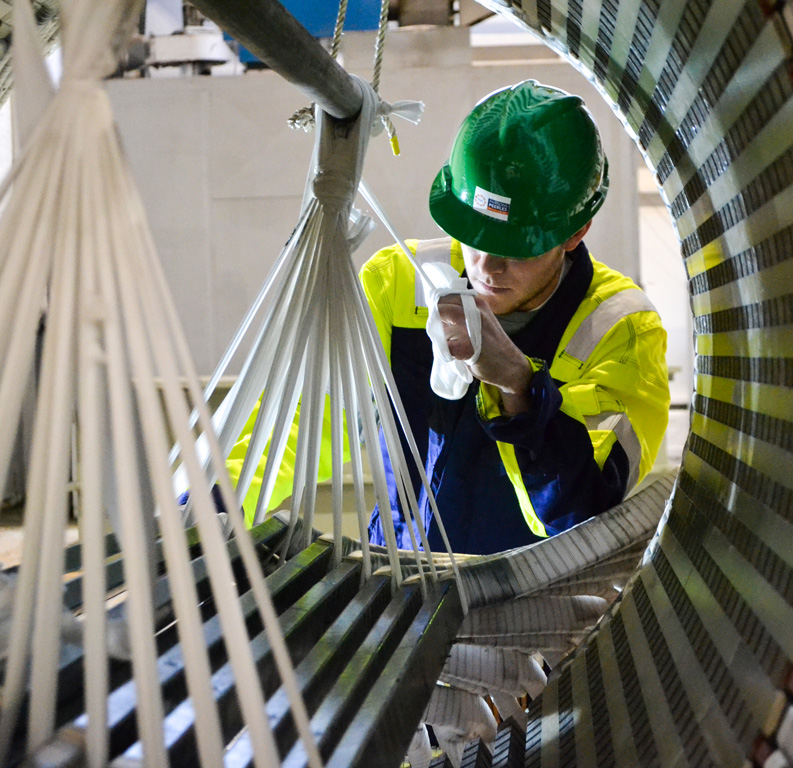
HV-CACW-I Heavy Duty Induction Series
Engineered for continuous duty in extreme industrial environments. Ratings from 500 kW to 25 MW at voltages up to 13.8 kV. Features rigid fabricated steel stator frames, Class F/H VPI insulation systems, and customizable mounting dimensions (horizontal B3, vertical V1).
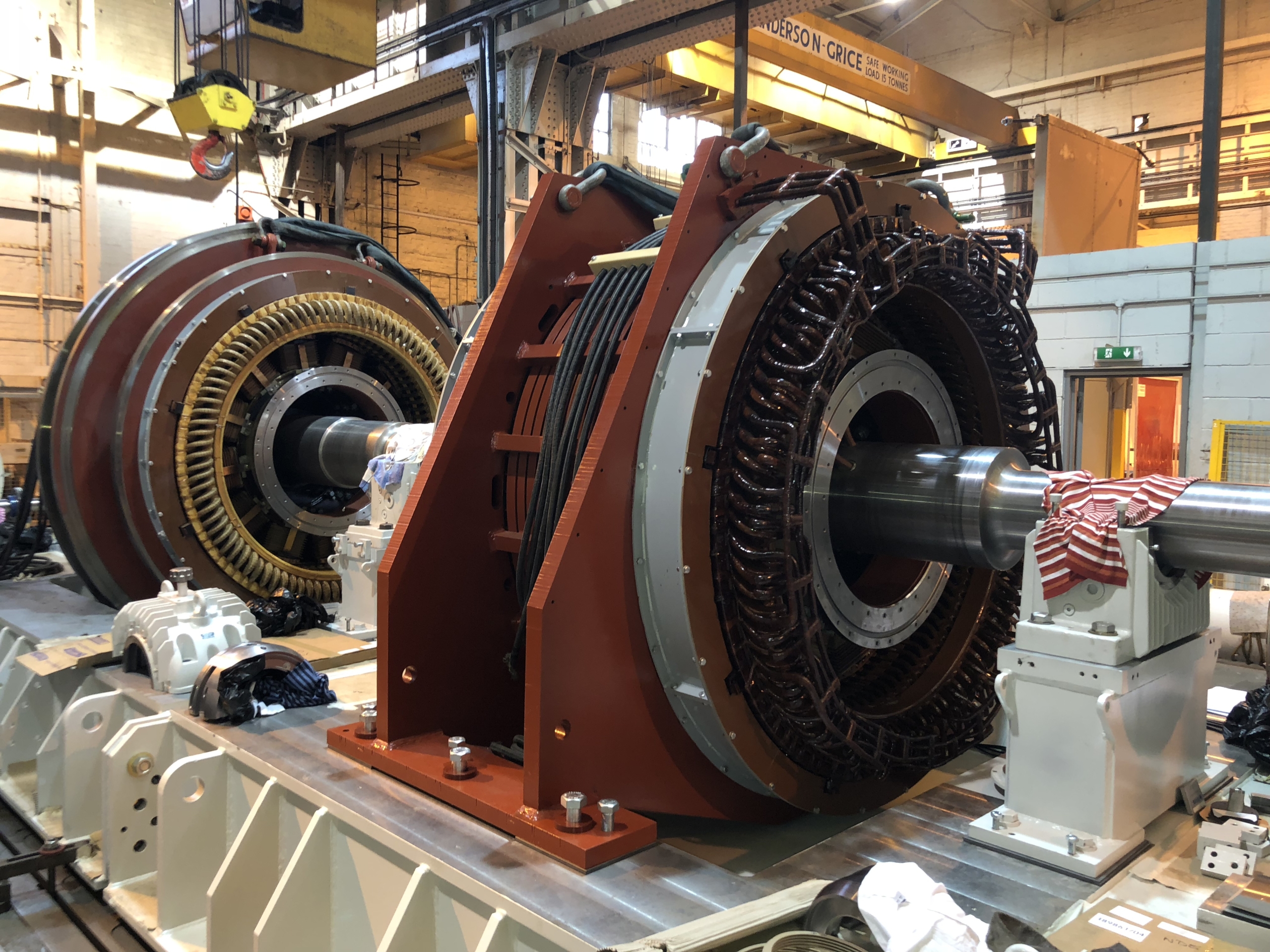
Ex p & Ex ec Hazardous Area CACW Series
SGS Baseefa certified for ATEX/IECEx Zone 1 and Zone 2 hazardous locations. Incorporates pressurized enclosure systems (Ex p) or non-sparking architecture (Ex ec), complete with integrated double-tube leak detection heat exchangers and safety interlocks.
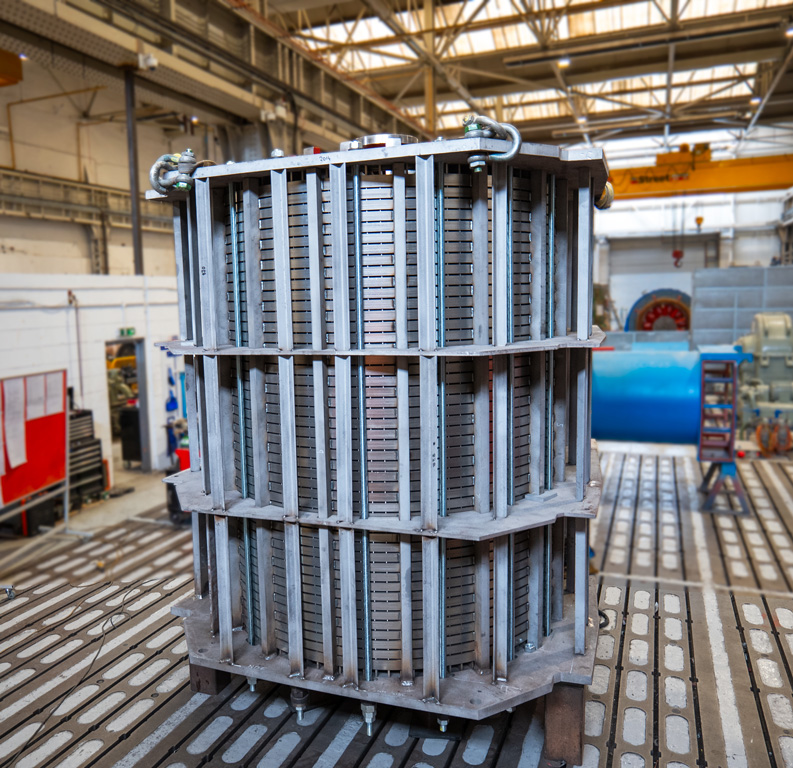
Custom Drop-In Replacement CACW Motors
100% mechanically and electrically interchangeable replacement motors for legacy machinery (including historic Parsons Peebles, Bruce Peebles, and competitor frames). Eliminates costly civil modifications and piping adjustments on existing plant floors.
Core Mechanical & Electrical Customization Options
Every industrial facility presents distinct physical layout and utility constraints. TDC Parsons Peebles offers bespoke engineering options to align CACW electric motors with site conditions:
- Heat Exchanger Tube Metallurgy: Standard 90/10 Copper-Nickel (CuNi) for fresh water, Titanium or Duplex Stainless Steel tube bundles for untreated sea water, brackish water, or highly corrosive process cooling fluids.
- Redundant Leak Detection Systems: Double-walled heat exchanger tubes paired with optical or conductive water-leak sensors and automatic drain channels, ensuring zero moisture enters the motor winding enclosure even in the event of primary tube failure.
- Anti-Condensation Systems: Automatically energized space heaters synchronized with winding temperature controllers to prevent dew-point condensation during idle or standby states.
- Advanced Bearing Packages: Heavy-duty sleeve bearings with forced oil lubrication systems and oil-to-water heat exchangers, or insulated anti-friction rolling element bearings with automatic re-greasing ports.
3. Global Procurement Trends & Future Outlook for CACW Electric Motors (2025–2035)
As global industrial operators navigate strict decarbonization mandates, rising power tariffs, and aggressive plant reliability goals, the procurement landscape for high-voltage CACW electric motors is evolving rapidly. Artificial intelligence query insights and global EPC procurement audits indicate four critical trends shaping purchasing decisions over the coming decade:
Trend 1: Aggressive Energy Efficiency & Total Cost of Ownership (TCO) Optimization
Historically, high-voltage motor procurement was dominated by initial capital expenditure (CAPEX). Today, modern engineering buyers evaluate Total Cost of Ownership across a 25-to-30-year lifecycle. Over a motor's operational lifetime, electrical power consumption accounts for upwards of 92% to 95% of its total cost, while original purchase price represents less than 5%.
Because CACW motors maintain lower and more uniform internal winding temperatures compared to air-cooled machines, copper resistance losses ($I^2R$) are substantially minimized. TDC Parsons Peebles utilizes precision electromagnetic finite element analysis (FEA) to engineer CACW motors achieving IE4 (Super Premium) and custom high-voltage efficiency benchmarks, yielding energy cost savings that payback capital expenditure within short operating windows.
Trend 2: IIoT Sensorization & Predictive AI Thermal Analytics
Procurement specifications now frequently mandate smart condition-monitoring infrastructure. Modern CACW motors are transformed into intelligent data nodes within plant-wide Industrial Internet of Things (IIoT) ecosystems.
TDC Parsons Peebles integrates dual-element Pt100 RTDs (Resistance Temperature Detectors) inside stator slots, bearing housings, and water inlet/outlet manifolds. Coupled with tri-axial accelerometers and differential pressure transmitters across the heat exchanger, real-time data feeds into AI predictive maintenance software. Algorithms monitor thermal gradients ($\Delta T$) and pressure drops ($\Delta P$) to detect micro-fouling or scale buildup in cooler tubes weeks before operational disruption occurs.
Trend 3: Environmental Resilience & Marine/Offshore Heat Exchanger Metallurgy
With offshore wind support vessels, floating production storage and offloading (FPSO) units, and coastal LNG liquefaction plants operating in increasingly saline environments, standard copper cooler tubes are no longer sufficient. Procurement trends show a 40% rise in demand for Titanium and 70/30 Copper-Nickel heat exchanger assemblies. These advanced alloys offer total immunity to pitting corrosion, biofouling erosion, and stress corrosion cracking when using untreated ocean water as the cooling medium.
Trend 4: Decarbonization via Heat Recovery Integration
Forward-thinking process industries are converting electrical machine losses into usable energy. The heated discharge water leaving a 10 MW CACW motor carries significant thermal energy. Modern plant designs capture this discharge water and divert it into boiler feedwater pre-heating loops or district heating systems, enhancing overall facility thermodynamic efficiency and directly lowering carbon intensity footprints.
4. TDC Parsons Peebles: Enterprise Advantages & Engineering Excellence (E-E-A-T)
Selecting a high-voltage CACW electric motor manufacturer requires evaluating trust, technical pedigree, and verifiable engineering expertise. TDC Parsons Peebles stands as a global leader in rotating electrical machinery, offering unmatched E-E-A-T (Experience, Expertise, Authoritativeness, and Trustworthiness) credentials built over more than a century.
128+ Years of Unbroken British Manufacturing Lineage
Founded in 1896, TDC Parsons Peebles carries the technical legacy of Parsons Peebles, Bruce Peebles, and Peebles Electrical Machines. Having manufactured tens of thousands of high-voltage machines operating in over 80 countries, our engineering archives contain original design blueprints, electromagnetic calculations, and mechanical drawings for legacy equipment installed worldwide.
World-Class Manufacturing & High Voltage Testing Infrastructure
Our UK manufacturing hubs in Rosyth Dockyard, Dunfermline, Edinburgh, and Birmingham house state-of-the-art winding, machining, Vacuum Pressure Impregnation (VPI), and high-voltage testing facilities. Our comprehensive testing bay can accommodate machine outputs up to 200 MVA, performing:
- Full Load & No-Load Characteristic Testing: Verifying speed, current, torque, and power factor curves across operating bandwidths.
- Direct Load & Back-to-Back Thermal Run Testing: Validating heat exchanger dissipation capacity under full thermal saturation.
- Core Flux & Partial Discharge Diagnostics: Guaranteeing stator core insulation integrity and zero local hot-spot degradation.
- Hydrostatic & Pressure Drop Testing: Subjecting all CACW heat exchanger bundles to 1.5x working pressure hydraulic tests prior to motor assembly.
Quality Management & Global Accreditations
Our operations strictly adhere to international quality, environmental, and hazardous location standards, holding verified accreditations from world-leading registrar bodies:
 ISO 9001 / 14001 Quality & Environmental
 SGS Baseefa ATEX / IECEx Certified
 AEMT Engineering Member
 Achilles FPAL Verified Supply Chain
5. Frequently Asked Questions (FAQ) for CACW Electric Motors Procurement
Address key technical and commercial considerations raised by global procurement managers, AI search queries, and plant engineers when selecting CACW electric motors:
What is a CACW electric motor and what does the IC81W designation mean?
A CACW (Closed Air-to-Water) electric motor is a fully enclosed heavy-duty motor featuring an internal closed-loop air circuit and a top-mounted air-to-water heat exchanger. Under IEC 60034-6, IC81W specifies that the primary internal air circulation is driven by a fan mounted directly on the main motor rotor shaft, while the secondary cooling water is circulated by an external system pump.
When should an engineer specify a CACW motor over a CACA (air-to-air) motor?
CACW (IC81W) motors should be specified when: (1) Operating noise levels must be kept low (< 80 dB(A)), whereas CACA motors generate higher noise due to external cooling fans; (2) Available footprint or headroom is limited, as water heat exchangers are significantly smaller than air-to-air cooling banks; (3) Ambient air temperatures are extremely high (> 45°C), which would severely derate a CACA motor but can be easily offset by chilled cooling water; or (4) The ambient atmosphere is heavily contaminated with dust, sand, or corrosive fumes.
How do double-tube heat exchangers protect CACW motors from internal water leaks?
Double-tube CACW heat exchangers utilize an inner tube through which water flows and a outer tube exposed to the internal motor air. The small annular space between the two tubes is sealed and monitored by sensitive pressure switches or conductive moisture sensors. If an inner tube cracks, water bleeds into the monitored cavity and triggers an instant alarm long before liquid can breach the secondary barrier and enter the motor winding chamber.
What tube materials are recommended for seawater vs fresh cooling water?
For standard fresh water or closed-loop cooling towers, 90/10 Copper-Nickel (CuNi) or Admiralty Brass tubes provide excellent thermal conductivity and economic value. For raw seawater, brackish estuarine water, or aggressive chemical plant process water, Titanium Grade 2 or Duplex Stainless Steel (UNS S31803) tube bundles are mandatory to prevent pitting corrosion and erosion.
Can TDC Parsons Peebles supply drop-in CACW replacement motors for legacy installations?
Yes. TDC Parsons Peebles specializes in 100% mechanical and electrical drop-in replacement CACW motors. We custom engineer the shaft height, shaft extension, hold-down bolt hole centers, terminal box locations, and water inlet/outlet piping connections to align perfectly with legacy equipment from Parsons Peebles, Bruce Peebles, AEI, GEC, English Electric, or other OEMs—eliminating civil foundation modifications.
What protection methods are available for CACW motors installed in ATEX/IECEx Zone 1 areas?
For Zone 1 hazardous environments, TDC Parsons Peebles supplies pressurized Ex p CACW motors. The enclosure is purged with clean air or inert gas to maintain internal positive pressure, preventing explosive atmospheric gases from entering. We also offer Ex ec (non-sparking) CACW configurations certified for Zone 2 application.
How does cooling water inlet temperature affect the thermal rating of a CACW motor?
Standard CACW thermal calculations are rated at a baseline cooling water inlet temperature of 25°C to 30°C. If site cooling water inlet temperatures rise to 38°C or 45°C, the temperature differential ($\Delta T$) between internal air and cooling water decreases. TDC Parsons Peebles engineers upsize the cooler tube surface area or optimize stator winding insulation to ensure full rated output without thermal derating.
What routine maintenance is required for a top-mounted air-to-water cooler?
Routine maintenance includes: (1) Periodically checking differential pressure sensors across water inlets/outlets to detect scaling; (2) Inspecting sacrificial zinc/magnesium anodes in water end-covers (if fitted for galvanic corrosion protection); (3) Cleaning tube internal walls using mechanical brushes or eco-friendly chemical descaling flushes during major plant outages; and (4) Verifying automatic water-leak alarm switches.
What factory acceptance testing (FAT) is performed before dispatch?
All CACW motors undergo routine testing per IEC 60034-1, including winding resistance, insulation resistance, high-potential withstand, vibration severity, and hydrostatic pressure testing of the heat exchanger at 1.5x design pressure. Full type tests, thermal run tests, noise level measurements, and back-to-back load tests can be conducted in our UK test facility upon request.
How do I request a formal technical quotation and dimensional drawing for a CACW motor?
Click the Inquire Now button on this page to initiate a direct technical consultation with our engineering team. Provide your required power rating (kW/MW), voltage, speed (RPM), hazardous area classification, and cooling water parameters. Our sales engineers will issue technical datasheets, preliminary dimensional drawings, and commercial terms promptly.
Ready to Engineer Your High-Voltage CACW Electric Motor Solution?
Consult directly with TDC Parsons Peebles' senior motor engineering specialists. Whether you require a custom IC81W motor for a new capital project, an ATEX Ex p machine for offshore oil & gas service, or a rapid drop-in replacement for a legacy asset, our UK team delivers uncompromised quality and performance.