





Choosing the China Best Salient Pole Synchronous Generators Supplier requires more than comparing prices or online rankings. These machines support hydropower stations, industrial plants, and renewable energy systems where stable voltage matters daily. A reliable supplier should demonstrate proven design experience, controlled manufacturing, and documented testing procedures. Look for clear information about rated power, voltage, frequency, speed, insulation class, cooling method, and excitation technology. These details reveal whether the generator fits your operating conditions.
A serious manufacturer should provide inspection records, routine test reports, and traceable component data. Factory experience becomes visible in practical details, such as balanced rotors, accurately machined poles, clean winding work, and protective packaging for sea transport. Ask how the supplier manages vibration, temperature rise, overspeed testing, and commissioning support. Independent certifications can help, but certificates alone are not enough. Site references and after-sales response often tell a clearer story.
No ranking stays perfect. A supplier with excellent equipment may still provide weak documentation or slow technical support. Buyers should verify production capacity, engineering staff, spare-parts availability, and warranty terms before signing a contract. Request drawings and performance curves early. Compare them with your grid conditions and load profile. In my experience, careful technical questions reveal more than impressive factory photographs. The best choice is not always the largest company. It is the supplier that combines dependable Salient Pole Synchronous Generators, transparent communication, tested performance, and support that remains available after delivery.
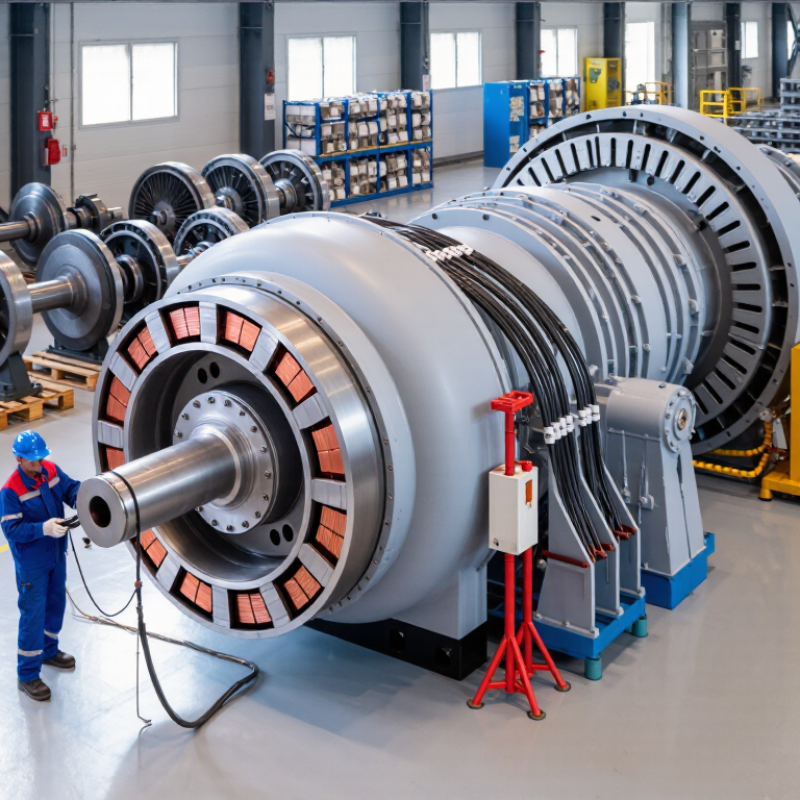
Salient Pole Synchronous Generators: Definition and Operating Principles
A salient pole synchronous generator has projecting magnetic poles fixed around its rotor. The rotor usually turns at a steady speed inside a stator carrying three-phase windings. Unlike a smooth cylindrical rotor, its uneven shape creates a clear difference between direct-axis and quadrature-axis reactance. This feature supports efficient operation at lower speeds.
During operation, direct current excites the rotor field. A prime mover, such as a water turbine or diesel engine, rotates the rotor. Its magnetic field then sweeps across the stator conductors and induces alternating voltage. The generated frequency depends on rotor speed and pole number. More poles allow stable generation at slower mechanical speeds. This design suits hydroelectric stations and other applications requiring strong torque.
Tips: Check the excitation system, air gap, bearings, and winding temperature during inspection. Listen for unusual vibration near the pole area. It may reveal imbalance or looseness. Keep the rotor speed synchronized with grid frequency before connection. In practical maintenance, measurements can disagree slightly. That is normal sometimes, but unexplained differences deserve investigation. Operators should also record voltage, current, power factor, and temperature under changing loads. A generator may appear stable while insulation aging develops quietly. Careful records provide stronger evidence than a single test.
| Technical Dimension | Definition or Specification | Typical Reference Data | Operating Significance |
|---|---|---|---|
| Machine Type | Rotating AC synchronous generator with projecting magnetic poles on the rotor. | The rotor field rotates at the same mechanical speed as the rotating stator magnetic field. | Provides a constant electrical frequency when operated at the required synchronous speed. |
| Rotor Construction | Laminated rotor spider with projecting pole bodies, pole shoes, field windings, and retaining components. | Normally uses multiple poles and a large rotor diameter with a short axial length. | The geometry is suitable for low-speed prime movers and supports high torque at relatively low rotational speed. |
| Synchronous-Speed Formula | Synchronous speed is calculated as ns = 120f / P. | ns = speed in revolutions per minute; f = frequency in hertz; P = total number of poles. | The formula is used to select the pole count for a specified grid frequency and prime-mover speed. |
| Speed Examples at 50 Hz | Mechanical speed required for selected pole counts. | 4 poles: 1,500 rpm; 8 poles: 750 rpm; 12 poles: 500 rpm; 24 poles: 250 rpm. | Higher pole counts allow direct coupling to slower hydraulic or reciprocating prime movers. |
| Speed Examples at 60 Hz | Mechanical speed required for selected pole counts. | 4 poles: 1,800 rpm; 8 poles: 900 rpm; 12 poles: 600 rpm; 24 poles: 300 rpm. | The operating speed must remain synchronized with the selected system frequency. |
| Stator Assembly | Stationary laminated iron core containing distributed three-phase windings. | The stator winding commonly produces a three-phase sinusoidal output. | A stationary armature simplifies insulation, cooling, and connection to the external electrical system. |
| Excitation System | Direct current is supplied to the rotor field winding to establish the magnetic field. | Excitation may use slip rings and brushes or a brushless exciter arrangement. | Adjusting field current controls terminal voltage and reactive-power exchange within operating limits. |
| Electromagnetic Principle | A rotating magnetic field cuts the stationary stator conductors and induces an electromotive force according to Faraday’s law. | The generated frequency depends on rotor speed and pole count. | Mechanical input power is converted into electrical power through electromagnetic induction. |
| Prime-Mover Compatibility | Designed for low-speed or medium-speed mechanical drives where a multi-pole rotor is advantageous. | Common applications include hydro turbines, low-speed diesel engines, wind turbines, and engine-generator sets. | Pole count and rotor dimensions are selected to match torque, speed, frequency, and mechanical constraints. |
| Voltage Regulation | An automatic voltage regulator adjusts the rotor field current in response to terminal-voltage conditions. | Voltage regulation depends on excitation response, load power factor, synchronous reactance, and control settings. | Maintains stable terminal voltage during changes in electrical load, within the generator’s rated capability. |
| Power-Factor Capability | A synchronous generator can supply or absorb reactive power by varying excitation. | The permissible power-factor range is defined by the capability curve and thermal limits. | Supports voltage control and reactive-power management when connected to an electrical grid. |
| Damper Winding | Conductive bars embedded in or connected across the pole faces, where provided. | Damper windings help reduce rotor oscillations and can contribute to starting in certain motor configurations. | Improves dynamic stability during load changes and transient disturbances. |
| Cooling Arrangement | Removes heat generated by stator copper loss, core loss, rotor-field loss, friction, and windage. | Cooling may use open-air, enclosed-air, air-to-air, air-to-water, or other engineered ventilation systems. | Adequate cooling is essential for insulation life, continuous operation, and rated power output. |
| Main Advantages | High torque capability, suitability for low-speed operation, and controllable reactive-power performance. | Well suited to high-power installations with comparatively low rotational speed. | Offers an efficient alternative to mechanically geared arrangements in many low-speed applications. |
| Main Limitations | Large diameter, greater mechanical complexity, and lower suitability for very high-speed operation. | The projecting poles experience higher mechanical stresses as speed increases. | Designers must carefully evaluate rotor strength, vibration, balancing, and ventilation requirements. |
| Selection Criteria | Frequency, rated power, rated voltage, speed, pole count, power factor, insulation system, cooling, and environmental conditions. | The final specification should be based on the prime mover, grid requirements, duty cycle, and installation conditions. | A complete technical evaluation helps ensure reliable synchronization, thermal performance, and long-term service life. |
Note: Reference values are typical engineering relationships and application characteristics. Final ratings and performance limits must be confirmed through the generator’s technical datasheet and capability curve.
They suit low-speed hydropower, diesel, biomass, and isolated microgrid systems. Their large diameter supports strong torque at roughly 100–600 rpm. That geometry can reduce speed-matching problems. Application fit matters more than price.
Compare rated power, voltage, frequency, speed, and power factor. Check excitation control, voltage regulation, cooling, insulation class, and short-circuit performance. The generator must match the driven machine and grid conditions. Small mismatches can create costly modifications.
Request efficiency curves and temperature-rise results under defined conditions. Review insulation resistance, overload, voltage regulation, noise, and short-circuit tests. Ask for routine and type-test procedures based on recognized electrical standards. Catalog images prove very little.
Request rotor balancing records, winding inspection reports, and material certificates. Review bearing design and factory acceptance test procedures. Vibration readings should identify speed, load, and measurement locations. Evidence matters. Independent verification may still be wise.
Give each supplier the same technical data sheet and operating conditions. Compare at least three quotations using identical requirements. Check partial-load efficiency, delivery milestones, testing scope, packing, and site support. A low price may exclude important services. That is easy to miss.
Confirm spare-parts availability, commissioning support, warranty terms, and response times. Ask for production schedules and named project milestones. Review references from similar power ranges and operating speeds. Some references may be selective. Keep questioning the evidence.
Coastal air, dust, altitude, heat, and humidity can affect cooling and insulation. The supplier should review the real load profile and installation conditions. Starting currents, load changes, and harmonics also require attention. A laboratory result may not match the site.
Review drawings, protection settings, test plans, efficiency data, and acceptance criteria. Confirm what testing, packing, transport, and site assistance include. Put every milestone in writing. Plans change. Unclear communication can cause expensive delays.
Salient Pole Synchronous Generators are reliable power-generation machines designed to produce stable electrical output at controlled speed and frequency. This summary explains their operating principles, including how the rotor’s projecting poles interact with the stator’s rotating magnetic field. It also introduces essential components such as the rotor, stator, excitation system, cooling structure, bearings, and control devices, while highlighting design features that support efficient operation at low and medium speeds.
For buyers evaluating a Chinese generator supplier, important considerations include rated capacity, voltage stability, efficiency, durability, customization capability, delivery performance, and after-sales technical support. Manufacturing standards, material inspection, assembly accuracy, electrical testing, balance testing, and quality-control procedures are also essential indicators of supplier reliability. Finally, the article outlines common applications in hydropower stations, industrial facilities, renewable-energy systems, and standby power projects, and provides practical guidance for comparing suppliers according to performance, compliance, production capability, and long-term service value.