





Engineered for extreme torque demands, grid voltage stabilization, power factor correction (&cos;φ optimization), and harsh industrial environments.
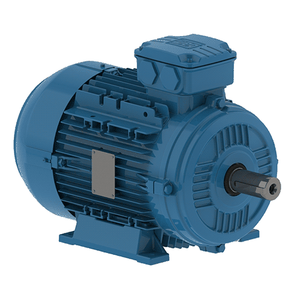
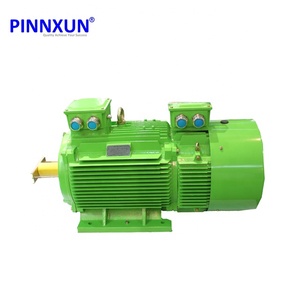
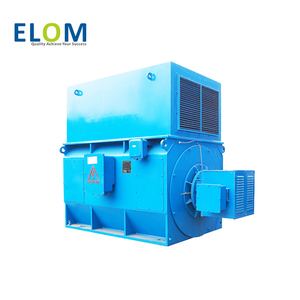
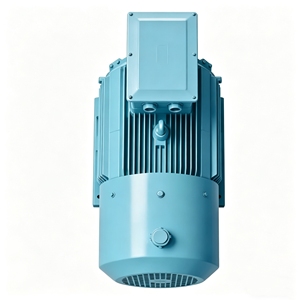
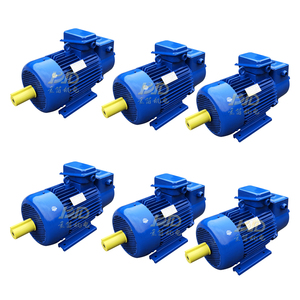
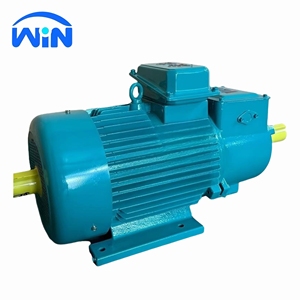
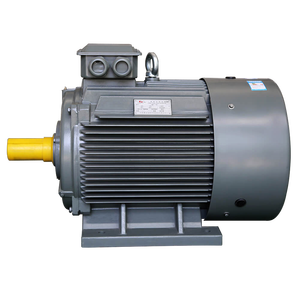
As global power grids undergo an accelerated transition from fossil-fuel thermal generation toward intermittent renewable sources (solar PV and wind power), transmission network operators (TSOs) and heavy industrial power users face an unprecedented challenge: **the sudden loss of dynamic grid inertia, severe voltage instability, and deteriorating power factor (&cos;φ)**.
Traditional power factor correction relies heavily on static capacitor banks or power electronics such as Static VAR Compensators (SVC) and Static Synchronous Compensators (STATCOM). However, while static converters supply reactive VAR power, **they cannot deliver physical rotational inertia ($H$) or high short-circuit capability ($S_{sc}$)** required to keep high-voltage transmission backbones stable during severe fault ride-through (FRT) events.
A synchronous condenser functions by manipulating its field excitation current ($I_f$). When over-excited, the machine acts as a large capacitive reactor, producing reactive power ($\text{VAR}_{leading}$) to offset inductive industrial loads such as large wound rotor induction motors, arc furnaces, and submersible pumps. Conversely, under under-excited conditions, it absorbs excess reactive VARs to prevent voltage runaway across lightly loaded high-voltage lines (Ferranti effect).
Integrating over 128 years of electrical machine heritage from legacy UK brands like Parsons Peebles with China's state-of-the-art heavy manufacturing infrastructure, modern synchronous condenser factories offer unparalleled technical excellence, competitive CAPEX, and rigorous quality control.
Manufactured under strict ISO 9001 systems and certified by SGS Baseefa for hazardous area environments (Ex ec, Ex p, Ex e).
Precision engineered to fit existing foundation footprints, shaft centerlines, and terminal box configurations with zero civil modifications required.
Full-scale Back-to-Back load testing, Core Flux testing, and dynamic balance up to 200MVA at rated system voltage (3.3kV-13.8kV).
Global energy procurement departments and EPC contractors are recalibrating their VAR compensation equipment sourcing strategies based on several key market shifts:
Rather than choosing between static electronics and rotating machines, modern procurement projects specify **Hybrid VAR Compensation Nodes**. In these turnkey installations, a high-response STATCOM handles sub-cycle high-frequency voltage fluctuations, while a China-manufactured synchronous condenser provides continuous bulk MVAR support, sub-transient fault current injection, and rotational inertia.
Factory-assembled skid platforms featuring integrated oil lubrication units, closed-circuit air-to-water heat exchangers (CACW / CACA), and digital Automatic Voltage Regulators (AVR) significantly shorten field installation timelines from months to weeks.
While static capacitor banks claim zero rotational losses, synchronous condensers designed with low-friction hydrogen or vacuum-sealed bearing enclosures drastically lower continuous active power losses ($\text{kW}_{loss}$) to under 1.2% of rated MVAR capacity, delivering superior 20-year TCO.
R&D hubs across top Chinese factories are pioneering major advancements in rotating power factor correction machinery:
By coupling vacuum-encapsulated carbon-fiber or forged steel flywheels directly to the generator rotor, dynamic inertia constants can be doubled ($H > 6.0 \text{ seconds}$), preventing sudden frequency drop ($dF/dt$) during renewable generation cut-offs.
Integration of fiber-optic partial discharge (PD) monitoring, wireless rotor temperature telemetrics, and real-time vibration spectrography allows plant operators to predict winding insulation breakdown 6 months prior to potential failure.
To aid industrial procurement managers, the table below evaluates the primary dynamic VAR compensation options:
| Performance Indicator | Synchronous Condenser | STATCOM (Static) | Capacitor Banks (SVC) |
|---|---|---|---|
| Physical Grid Inertia (H) | High (2.5 - 6.5s) | None (0s) | None (0s) |
| Short Circuit Current Support | Up to 500-800% (Sub-transient) | Limited (100-120%) | Zero (Reduces with voltage drop) |
| Response to Severe Voltage Drops | Increases VAR Output Automatically | Constant Current Output | VAR output drops squared ($V^2$) |
| Harmonic Distortion Generation | Pure Sine Wave (Zero Harmonics) | Requires Active Filtering | Can cause resonance |
| Equipment Operational Lifespan | 30 - 50+ Years | 12 - 15 Years (IGBT aging) | 10 - 15 Years |
A synchronous condenser regulates plant power factor (&cos;φ) by adjusting its DC rotor excitation. By over-exciting the field windings, the machine injects reactive VARs into the plant distribution system, counteracting the lagging reactive power produced by induction motors, transformers, and heavy equipment. This elevates plant power factor up to 0.98–1.0, eliminating utility low power factor penalty fees.
Standard manufacturing capabilities span medium to high voltage ratings including 3.3kV, 6.6kV, 10kV, 11kV, and 13.8kV at 50Hz or 60Hz. Direct grid connection eliminates the need for expensive step-up intermediate transformers in many industrial sub-stations.
Capacitor banks provide static reactive power, but their VAR output drops proportionally to the square of grid voltage during a fault ($Q \propto V^2$). When grid voltage drops drastically, capacitor banks fail to provide support. In contrast, synchronous condensers inject massive sub-transient dynamic reactive currents and natural kinetic inertia, maintaining grid stability during severe voltage dips.
Key maintenance tasks include periodic bearing lubrication analysis, air filter replacement for CACA/CACW cooling systems, brush inspection (for brush-type excitation units), rotor insulation testing, and partial discharge online monitoring. Brushless static excitation designs eliminate carbon brush wear entirely.
Yes. Chinese factories excel in engineering 100% mechanically drop-in replacement units. Whether replacing an obsolete slip-ring motor (such as YR or YZR series) or adding dynamic power factor correction, customized shaft heights, mounting hole layouts, and terminal configurations ensure seamless field integration.
Export equipment typically carries ISO 9001 quality compliance, CE compliance, IEC 60034 series standards, and ATEX/IECEx certifications for explosive dust or gas environments (Ex ec, Ex p, Ex e).
Contact our senior engineering team for tailored power factor correction calculations, synchronous condenser technical datasheets, and factory-direct B2B price quotations.