




Precision-engineered slip ring induction motors, high-torque wound rotor machines, and custom industrial fan motors built for France's power, heavy industry, and nuclear infrastructure.
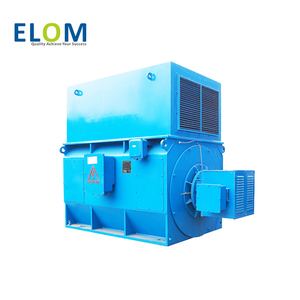
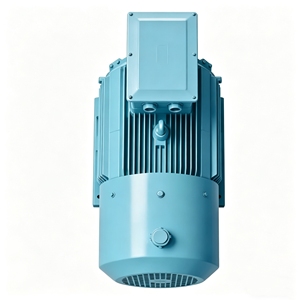
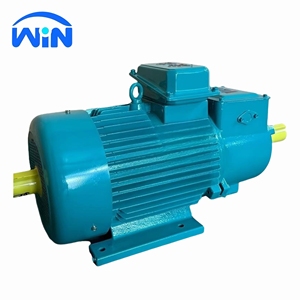
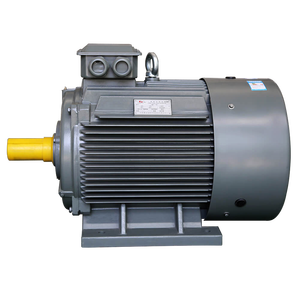
Partial Discharge (PD) analysis has evolved from a periodic offline quality assessment tool into a mandatory diagnostic standard for medium-voltage (MV) and high-voltage (HV) rotating electrical machines across France’s industrial ecosystem. In critical energy infrastructure—ranging from Electricité de France (EDF) nuclear auxiliary pumping systems to high-altitude hydroelectric facilities in the Rhône-Alpes and offshore grid interconnectors off the coast of Normandy—insulation integrity dictates plant availability, operational safety, and asset lifecycle economics.
As an OEM export partner and advanced manufacturing facility, our engineering protocol integrates rigorous offline and online Partial Discharge testing compliant with IEC 60270, IEC 60034-27, and IEEE 1434 standards. By detecting localized dielectric breakdown within the stator winding mica insulation matrix before catastrophic breakdown occurs, our machinery guarantees maximum reliability under demanding duty cycles.
In high-voltage electric motors and generators operating above 3.3 kV, the insulation system is subjected to severe electrical, thermal, mechanical, and environmental (TEAM) stresses. Partial discharge refers to localized electrical discharges that only partially bridge the insulation between conductors or between a conductor and ground. While individual PD pulses are microscopic (typically measured in picocoulombs, pC), sustained PD activity erodes organic resins, creates conductive treeing pathways, and degrades the inorganic mica tape backbone over time.
Occurs within microscopic voids trapped inside the Vacuum Pressure Impregnation (VPI) epoxy resin during manufacturing. High PD inception voltage (PDIV) indicates superior VPI resin fill density.
Caused by movement of the stator bar within the core slot, eroding the conductive outer armor tape. Prevented in our factories via precision conductive slot packing and semi-conductive paint coating.
Occurs at the overhang region where high voltage gradients meet contamination, moisture, or insufficient phase-to-phase clearance. Neutralized by non-linear stress control varnish.
To deliver true "Information Gain" for engineering teams in France, raw pC values are insufficient. Our manufacturing facilities utilize Phase-Resolved Partial Discharge (PRPD) pattern recognition algorithms to map pulse phase position against the 50 Hz sinusoidal voltage wave. This allows precise differentiation between harmless background noise, slot spark discharges, and critical internal delamination.
| PD Testing Mode | Applicable IEC Standard | Measurement Sensors Used | Acceptance Thresholds for France Delivery |
|---|---|---|---|
| Factory Offline PD Test | IEC 60034-27 / IEC 60270 | Coupling Capacitors (80 pF - 1 nF), Quadripole Filters | < 100 pC at 1.0 Un | < 250 pC at 1.2 Un (VPI Class H) |
| Online Monitoring (In-Situ) | IEC 60034-27-2 | Permanent High-Voltage Coupling Capacitors, HFCT Sensors | Trend-based: < 2x baseline amplitude change over 12 months |
| UHF Acoustic PD Screening | IEEE 1434 / AFNOR Compliant | Piezoelectric Acoustic Sensors (40-300 kHz), UHF Antenna | Zero acoustic acoustic activity exceeding background ambient noise floor |
| Dielectric Dissipation (tan δ) | IEC 60034-27-3 | Precision High Voltage Schering Bridge | Δtan δ (0.6 Un to 0.2 Un) < 0.002; Tip-up limit strict compliance |
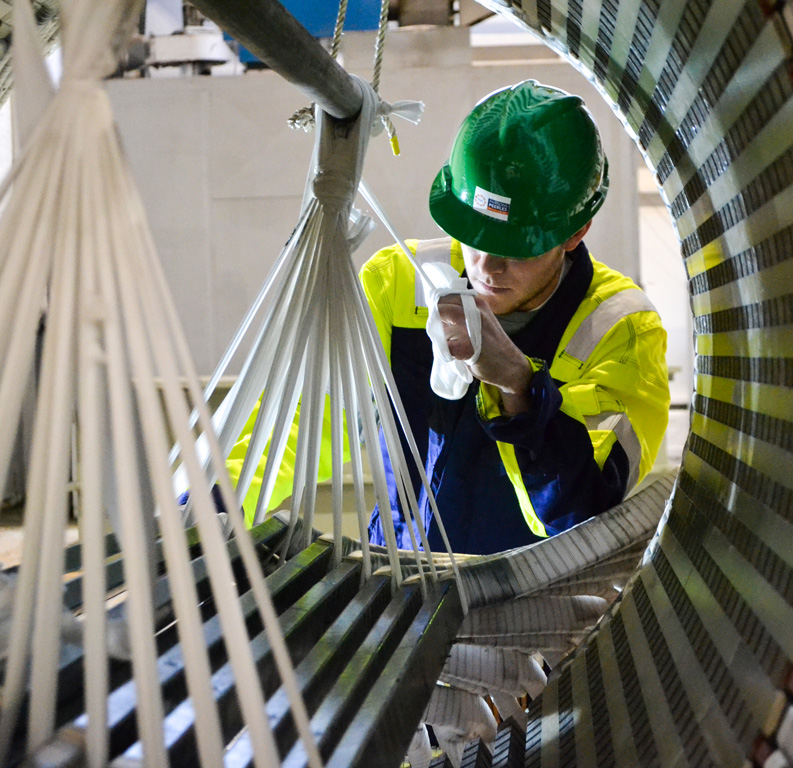
Every high-voltage slip ring motor, synchronous generator, and custom fan drive delivered to French buyers features our proprietary Resin-Rich and Vacuum Pressure Impregnation (VPI) epoxy mica tape system. By utilizing synthetic mica paper backed with glass cloth and impregnated with solventless epoxy resin under high pressure vacuum (under 1 mbar), we achieve zero-void insulation matrices capable of enduring severe harmonic stresses from modern Variable Frequency Drives (VFDs) without PD degradation.
Engineering customized electrical rotating equipment built to withstand France's stringent environmental, grid-code, and safety regulations.
Supply of seismic-qualified, low-PD high-voltage motors for cooling pumps, essential service water, and emergency ventilation systems across Normandy and Grand Est nuclear facilities, meeting EDF M310 and NT-88 technical specifications.
High-torque YR wound rotor motors and salient pole synchronous generators deployed in pump-storage and run-of-river installations across Auvergne-Rhône-Alpes. Designed for rapid start-stop cycles and high moisture resistance.
Heavy-duty YZR crane motors and marine-grade slip ring induction motors engineered for port container cranes in Le Havre and Marseille-Fos, as well as offshore wind turbine yaw/pitch auxiliary drives with IP66 corrosion protection.
Ex p (pressurized) and Ex ec (increased safety) ATEX certified high-voltage induction motors operating in Zone 1 and Zone 2 hazardous areas across France's major chemical corridors, featuring real-time PD and gas purge control systems.
France’s industrial sector is undergoing a profound structural transition shaped by the Loi Énergie-Climat (Energy-Climate Law) and ambitious European Union net-zero carbon mandates. This shift directly impacts how high-voltage rotating electrical machinery is specified, operated, and maintained across the country.
Direct technical answers regarding factory testing, export compliance, European standards, and logistics for French industrial buyers.
Backed by over 128 years of rotating electrical machinery engineering heritage (with legacy brands including Parsons Peebles, TDC, and Electric Products Cleveland Ohio), our manufacturing facilities represent the pinnacle of European electrical machine design.
Our state-of-the-art manufacturing plants are equipped with full-scale high-voltage testing bays capable of conducting direct load, back-to-back load, core flux density testing, and full dielectric diagnostic evaluations on electrical machines rated up to 200 MVA total output.