





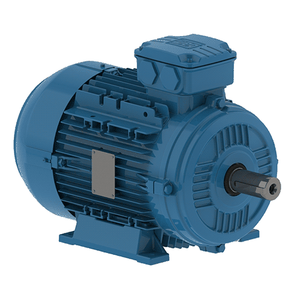
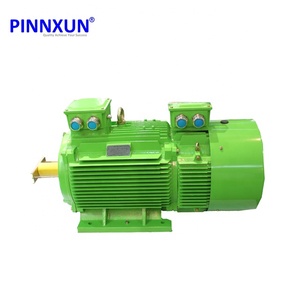
Vertical Hollow Shaft (VHS) induction motors represent the cornerstone of municipal water extraction, deep-well turbine pumping, and storm runoff mitigation throughout the Greater Chicago metropolitan area. Operating across the Lake Michigan watershed and the expansive infrastructure managed by the Metropolitan Water Reclamation District of Greater Chicago (MWRD), these electro-mechanical prime movers are exposed to distinct mechanical, thermal, and hydraulic stresses requiring specialized engineering designs.
1. The Hollow Shaft Advantage & Axial Thrust Bearings
Unlike standard horizontal or solid-shaft vertical motors, a Vertical Hollow Shaft motor allows the driven pump shaft to extend upward through the entire length of the motor's rotor shaft. The pump head adjustment nut is positioned conveniently at the top of the motor housing. This configuration permits precise vertical adjustment of the pump impellers within the submerged pump bowls without requiring the dismantling of the motor assembly or major piping connections.
Crucial to VHS survival under high-head pumping conditions is the top-mounted thrust bearing system. In deep-well applications exceeding 300 feet or stormwater lift stations operating under variable hydraulic heads, downthrust forces can reach tens of thousands of pounds. Our VHS motor designs integrate heavy-duty Spherical Roller Thrust Bearings or Duplex Angular Contact Ball Bearings, backed by high-capacity oil reservoirs and forced lubrication loops, ensuring a minimum L10 bearing life exceeding 100,000 hours under rated continuous thrust loads.
2. Non-Reverse Ratchet (NRR) Protection Mechanisms
When a vertical turbine pump shuts down, the liquid column remaining inside the discharge column pipe flows backward through the pump under gravity force. This reverse hydraulic fluid stream acts as a turbine, driving the pump and motor in reverse at velocities that can exceed 150% of rated synchronous speed. Reverse rotation creates immense centrifugal stress, uncouples threaded pump shafts, and destroys sleeve bearings.
To eliminate reverse-rotation damage, our Chicago-bound VHS motors feature integrated Pin-Type or Ball-Type Non-Reverse Ratchets (NRR). As the rotor accelerates in the forward direction, centrifugal force lifts the hardened steel pins or balls off the stationary ratchet plate, ensuring frictionless operation. Upon power loss or shutdown, gravity drops the pins immediately, locking the shaft against reverse rotation within a fraction of a single revolution.
3. NEMA Weather Protected Type II (WPII) & Freeze Protection
Chicago experiences extreme seasonal thermal dynamics, ranging from summer ambient highs above 95°F (35°C) to sub-zero winter temperatures reaching -20°F (-29°C) with lake-effect wind humidity. VHS motors installed at outdoor lift stations or open-well pumping facilities require NEMA Weather Protected Type II (WPII) enclosures.
Our WPII enclosures incorporate intake and exhaust air passages configured with at least three 90-degree directional changes. This baffling structure decelerates incoming high-velocity air streams (exceeding 100 mph wind gusts off Lake Michigan), dropping out heavy moisture, snow particulates, and debris before the air reaches the electrical active parts. Integrated space heaters maintain internal motor temperatures above dew point during winter standby periods, preventing dielectric degradation of Class H vacuum pressure impregnated (VPI) insulation system.
| Specification Parameter | Standard Commercial VHS | TDC Parsons Peebles Severe-Duty VHS |
|---|---|---|
| Single Angular Contact Bearings | High-Thrust Spherical Roller + Guide Bearings | |
| Class F Dip & Bake (105°C rise) | Class H VPI with Mica-Tape (80°C rise at 1.15 SF) | |
| Optional External Band Brake | Integral Pin/Ball Non-Reverse Ratchet (NRR) | |
| Standard WPI (Open Drip Proof) | NEMA WPII / IEEE 841 / IP55 Weather Protected | |
| Standard Flanged Coupling | Self-Aligning Heavy P-Base Drive Coupling | |
| NEMA MG-1 Standard (< 0.15 in/s) | Precision Balanced Precision Band (< 0.05 in/s) |