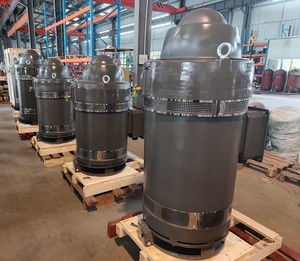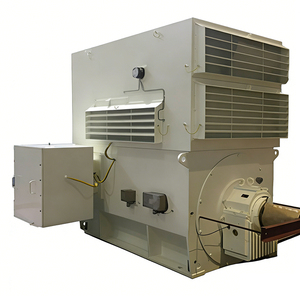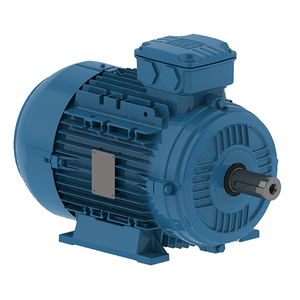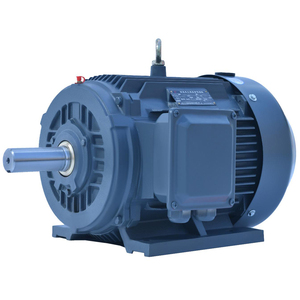





The industrial landscape of the Osaka Bay Area (Osaka-wan) and the surrounding Kansai economic zone represents one of Japan's most demanding operating environments for rotating electrical machinery. Ranging from heavy chemical processing complexes in the Sakai-Senboku coastal industrial zone to high-capacity municipal flood defense drainage stations along the Yodo and Yamato Rivers, plant engineers require electric motors that deliver exceptional reliability under aggressive environmental and electrical conditions.
Weather Protected Type II (WPII / NEMA WPII / IC01 / IP24W) electric motors represent the pinnacle of open-ventilated machine architecture for outdoor installations. Unlike standard Totally Enclosed Fan Cooled (TEFC / IC411) motors that rely on external surface cooling fins and suffer from thermal dissipation limitations at megawatt-level power outputs, WPII motors utilize advanced internal aerodynamic paths to draw ambient air directly across active electrical components while shielding internal windings from heavy moisture, wind-driven rain, sand, and coastal salt spray.
As a global high-voltage motor OEM with over 128 years of manufacturing heritage (inheriting premier engineering standards from Parsons Peebles and European heavy electrical traditions), our manufacturing facilities produce bespoke, high-efficiency WPII induction and synchronous motors tailored precisely for the Osaka and Kansai industrial grid specifications (60Hz / 200V / 400V / 3.3kV / 6.6kV / 11kV).
In Osaka’s humid subtropical climate (Cfa), ambient temperatures frequently exceed 35°C in summer with relative humidity above 85%, combined with airborne salt particles from Osaka Bay. Standard TEFC motors above 1,000 HP require massive frame sizes to dissipate heat due to air-to-frame thermal resistance. A WPII enclosure (NEMA MG-1 Part 1.25.9 / IEC 60034-6 IC01) achieves up to 40% higher thermal dissipation density while utilizing tortuous air-path velocity drop chambers to reject 98% of airborne moisture and particulate matter before it reaches the stator core.
To comply with strict Japanese Industrial Standards (JIS C 4034) and international NEMA/IEC standards, our WPII motors engineered for the Osaka market incorporate a multi-stage aerodynamic intake hood designed to neutralize extreme typhoon weather and marine atmospheric salinity.
The intake top-hood forces incoming cooling air through at least three abrupt 90-degree directional shifts. This radical change in velocity vector causes heavy water droplets, sea fog, and suspended solids to lose kinetic energy and drop harmlessly out of the air stream before reaching the internal rotor assembly.
Our WPII air housing features an enlarged low-velocity expansion chamber. Air speed drops below 300 feet per minute (1.5 m/s), allowing finer aerosol particles to settle into stainless steel drain channels equipped with one-way non-return check valves for automatic moisture evacuation.
Stator windings undergo Vacuum Pressure Impregnation (VPI) with 100% solid epoxy resins. Coils receive a high-build anti-tracking tropicalization coat, certified to withstand 3,000 hours of continuous ASTM B117 salt spray exposure common in coastal Osaka port terminals.
Osaka’s industrial footprint requires tailored motor configurations depending on geographic location, power grid harmonics, and driven equipment torque characteristics. Our factory direct supply caters to four critical sectors in the Kansai area:
Osaka features extensive low-lying land defended by massive stormwater pumping facilities. Our VHS (Vertical Hollow Shaft) and Vertical Solid Shaft WPII motors (100 HP to 5,000 HP) drive large axial and mixed-flow pumps. Equipped with anti-reverse ratchets, high-thrust spherical roller bearings, and IP55 terminal boxes, these units handle high axial thrust loads during typhoon surge events without risking electrical breakdown.
Operating in continuous-duty hydrocarbon processing plants, our high-voltage WPII motors deliver 200 HP to 10,000 HP powering centrifugal compressors, heavy crude transfer pumps, and boiler feed pumps. Featuring non-sparking Ex ec (Zone 2) and Ex p (pressurized) certifications, they integrate seamless vibration monitoring (accelerometers/proximity probes) aligned with Japanese plant safety codes.
Dry docks and container handling terminals along Osaka Port require robust, high-torque drive systems. We supply high-efficiency dynamic DC and AC induction WPII motors engineered to handle heavy cyclic overloads, rapid acceleration torque, and coastal marine corrosion without insulation degradation.
Kansai's metallurgical and industrial machinery plants rely on our 6-pole and 8-pole low-speed high-torque WPII induction motors. Utilizing 100% electrolytic copper rotor bars and slot-wedged stator cores, these machines eliminate harmonic rotor heating when driven by modern medium-voltage VFDs (Variable Frequency Drives).
Selecting the appropriate cooling enclosure design directly impacts capital expenditure (CAPEX), operational efficiency (OPEX), and plant footprint. The table below details technical trade-offs for high-capacity applications in the Kansai grid environment (60Hz operation):
| Feature Parameter | WPII (NEMA Weather Protected II / IC01) | TEFC (Totally Enclosed Fan Cooled / IC411) | CACA (TEAO Air-to-Air Exchanger / IC611) |
|---|---|---|---|
| Target Power Range | 200 HP – 10,000 HP+ (Ideal for High MW Output) | 0.5 HP – 1,500 HP (Limited by fin surface area) | 1,000 HP – 20,000 HP (Heavy industrial duty) |
| Ingress Protection Level | IP24W / IP23 (With drop-out baffled hood) | IP55 / IP56 (Dust-tight and water jet protected) | IP55 / IP56 (Fully isolated internal air circuit) |
| Cooling Efficiency Density | Very High (Direct internal airflow ventilation) | Moderate (Constrained by external thermal barrier) | High (Requires large external heat exchanger tube bank) |
| Footprint & Weight | Compact & Lightweight (Reduced foundation CAPEX) | Standard in small sizes; Huge frames above 1000HP | Large & Heavy (Top-mounted heat exchanger module) |
| Kansai 60Hz Efficiency (IE Rating) | Up to IE4 / Super Premium Efficiency (97.8% - 98.5%) | IE2 / IE3 / IE4 (Higher windage losses in big sizes) | IE3 / IE4 (Additional internal/external fan load) |
| Osaka Bay Marine Coating | C4/C5 Marine Polyurethane + VPI Class H Sealant | Standard Epoxy or C3 Marine Paint | C4/C5 Heavy Industrial Marine Paint System |
Replacing aging rotating machinery in established Osaka industrial facilities presents major structural challenges. Existing concrete foundations, pipe headers, terminal box entries, and shaft center heights (AH dimensions) cannot be altered without incurring millions of Yen in civil downtime costs.
Our factory engineering team specializes in reverse-engineering existing legacy motors (including vintage Japanese OEM brands such as Mitsubishi, Hitachi, Toshiba, and Yaskawa). We custom-manufacture replacement WPII motors matching exact shaft extension dimensions, foot-hole centers, terminal box positions, and coupling interfaces.
Every stator core is subjected to Core Flux Testing to verify zero inter-laminar shorts before winding. Coils utilize premium mica tape insulation impregnated via automated computer-controlled VPI autoclaves, guaranteeing void-free insulation capable of enduring steep voltage wave-fronts from modern IGBT VFDs.
Prior to shipment to Osaka, machines undergo comprehensive testing at our state-of-the-art testing facility: including No-Load Testing, Full Direct Load Testing, Back-to-Back Equivalent Load Testing, and Dynamic Rotor Balancing to ISO 1940 Grade G1.0 standards.
Below are technical solutions to frequent procurement questions asked by plant managers, EPC contractors, and maintenance directors across Osaka and the Kansai region:
Whether you require high-efficiency replacement motors, vertical hollow shaft pump drives for flood defense, or severe-duty high-voltage induction motors for chemical plants in Sakai-Senboku, our engineering team delivers precision-built solutions backed by 128+ years of technical authority.